Sunday, October 6, 2013

Blog Post: Immigration

To become a citizen of the United States, you must follow a multi-step process. First you must apply for a green card, or visa. Then you must live in the United States for 5 years. At this point you are elgible to take the Naturalization Test and become an official US citizen. The Naturalization Exam tests your knowledge off "Be able to read, write, and speak English and have knowledge and an understanding of U.S. history and government." In the spring of 2013 after months of behind the scenes meetings, a group of eight senators (including John McCain, Chuck Schumer, Lindsey Graham, and Marco Rubio) announced they had agreed on a framework for comprehensive immigration reform. After months of negotiation the group unveiled a bill that: Increased HB-1 Visas (supported by Tech companies), a pathway to citizenship, increased border security, and Guest-Worker Program). It was praised by both sides of the aisle and the non-partisan CBO even said it would lower the deficit. On June 27, 2013 the Senate passed the bill. However, the House has refused to even take up the bill. Instead the House insists that comprehensive immigration reform would be a mistake, they believe the issue would be better addressed by a series of small bills. The House is yet to pass a single one of these bills. The Government shutdown has further delayed reform efforts, leaving the fate of the Senate bill uncertain. 


http://www.uscis.gov/portal/site/uscis/menuitem.eb1d4c2a3e5b9ac89243c6a7543f6d1a/?vgnextoid=86bd6811264a3210VgnVCM100000b92ca60aRCRD&vgnextchannel=86bd6811264a3210VgnVCM100000b92ca60aRCRD
http://politicalticker.blogs.cnn.com/2013/10/05/gop-floats-six-week-funding-and-debt-ceiling-extension/?hpt=hp_c2
http://www.bloomberg.com
http://www.marketwatch.com/economy-politics?link=MW_Nav_EP
http://blogs.reuters.com/reihan-salam/files/2012/12/rubio.jpg
http://guardianlv.com/wp-content/uploads/2013/05/immigration-reform-e1364745667867.jpg


Blog Post: Ted Talk

I was very surprised to learn that there are real differences in the makeup of a liberal personality, and a conservative personality. For example, the average liberal is significantly more open to new experiences then the average conservative. In addition, it was fascinating to learn that you are born with a predisposition to a certain ideology, children are not born as a "blank slate." However, nature is still the most important part of choosing your political ideology. Another interesting fact was that conservatives prefer loyalty and protectivness, while liberals value friendliness and creativity.


I had a personal connection with the video. Both my parents are Clinton Democrats, even though everyone else in my extended family is a staunch conservative. When I formulated my first political opinion, and supported George W. Bush in the 2004 Presidential Election my mom told me I got my political leanings from my Grandpa. Ever since I have always believed my that I was born with a predisposition to conservatism. My environment just helped to bring out the trait. I studied this same topic in my Eight grade history class. My teacher then said people are either liberal or conservative based on what interest group they fall into. He said a person's personality does not play a critical role in their voting habits. However, Jonathan Haidt disproved this theory completely. 

My only question is what political party does Jonathan Haidt belong to? Prior to the 2004 Election Mr. Haidt was a liberal who believed conservatism was a “Frankenstein monster.”
However, after stumbling across a book about conservatism at bookstore in New York City Mr. Haidt started a year long transition to the political center. He now identifies himself as a centrist. 


http://www.washingtontimes.com/news/2012/jun/26/righteous-mind-author-haidt-conservatives-have-bro/?page=all
http://thumbs4.ebaystatic.com/d/l225/pict/121080275359_2.jpg
http://i.livescience.com/images/i/000/022/828/original/democrat-republican.jpg?1324227136

Wednesday, October 2, 2013

Blog Post: Amendments


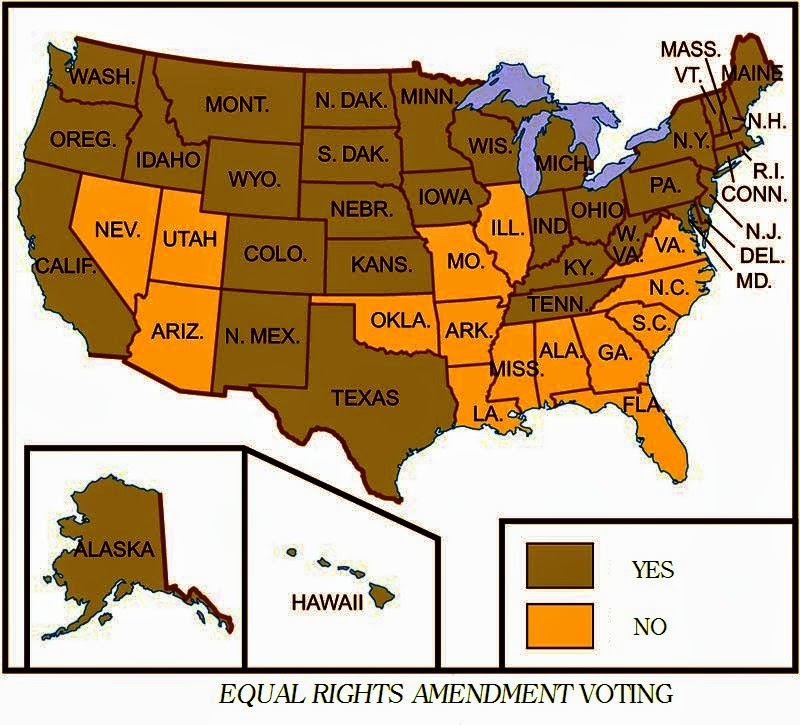
Correction: The 15 states whose legislatures have not ratified the Equal Rights Amendment are Alabama, Arizona, Arkansas, Florida, Georgia, Illinois, Louisiana, Mississippi, Missouri, Nevada, North Carolina, Oklahoma, South Carolina, Utah, and Virginia.


http://www.equalrightsamendment.org/
http://images.virtualology.com/images/5142.jpg
http://images.cpcache.com/merchandise/514_400x400_NoPeel.png?region=name:FrontCenter,id:41911605,w:16

Thursday, September 19, 2013

Issue Post: Federalism

Federalism plays a key role in both our national debt, and our financial system. Both the Federal Government and States regulate the financial industry. The Federal Government operates the SEC CFBP, FDIC.  The SEC regulates the operations of banks all over the United States, as does the CFBP. The FDIC insures bank deposits for all banks across the USA. The Federal Government justifies the creation, and operation of these regulatory agencies by invoking the Commerce Clause. State regulatory agencies only regulate the operations of banks within their states. The near collapse of insurer AIG exposed some of the flaws in this system. While its Financial Products division was regulated by the Federal Government, many of its insurance subsidiaries were regulated by separate states. When losses piled up at Federally regulated AIG FP, AIG couldn't get approval to sell it's different subsidiaries fast enough from the States. This lead to a liquidity crisis that resulted in AIG being forced to take a tax payer financed bailout. On the debt front, almost all States are required in their Constitutions to have a balanced budget. Obviously, the Federal Government does not have these requirements. However in cases of fiscal emergency such as the 2008 financial crisis, the Federal Government will lend money to embattled States. The States will then follow Federal instructions on when to pay it back. Also the Federal Government will often tie grants with following new Federal Laws. This is called Fiscal Federalism. For example, when the Federal Government wanted to raise the drinking age to 21, they forced States to comply by making new highway funding dependent on raising the drinking age to 21.


http://www.britannica.com/EBchecked/topic/203491/federalism
http://www.slowmoneynw.org/wp-content/uploads/2013/09/us-securities-and-exchange-commission.jpg


New Yorker Article

Before reading this article in the New Yorker I did not know several basic facts in the gun debate. I had no idea there were 300 million guns in America. In the United States today there is one gun for every man, woman, and child in this country. In addition I had no idea that the NRA's main purpose used to be protecting the recreational/hunting use of the rifle. This differs significantly from today when the NRA's main purpose is protecting the 2nd amendment, and fighting gun control laws. Also, I had no idea that although there are 300 million guns in America, the amount of households owning guns has declined since the 1970s. The gun control debate reminds me of the debate over our national debt. Both sides have dug into their respective positions. There is little to no room for debate. Instead insults are hurled by both sides, and in the mean time no progress is made on either issue. The gun debate affects me personally because my cousin is Police Officer in the SFPD. He says that the prevalence of firearms in America makes his job significantly harder. He claims police work would safer, and easier if gun laws were tightened. My only question is what was the fate of recent gun control legislation in Congress. Answer: Even with President Obama's full support gun control legislation failed to pass the Senate.


http://www.gallup.com/poll/165563/remains-divided-passing-stricter-gun-laws.aspx
http://www.gunpolicy.org/firearms/region/united-states
http://www.rkbablog.com/wp-content/uploads/2013/01/Cartoon-Chicago-style.jpg

Thursday, September 12, 2013

Issue Post: Constitution

Under the Constitution, the financial sector is regulated by the executive branch of the Federal Government under Article II Section 3 of the Constitution. Although the organizations and regulations are created by Congress under Article I Section 2 of the constitution. For example during the Great Depression, Congress created the Securities and Exchange Commission. However, after it was created the executive branch has picked the Chairman of the SEC, and operated it. To justify the creation of these national financial regulatory agencies, Congress uses the Commerce Clause of the Constitution, along with the Elastic Clause. The Constitution says nothing specific about the national debt. It is neither encouraged nor denied. In recent years several prominent Republican lawmakers have voiced their support of a Balanced Budget Amendment to the Constitution. This amendment would forbid the Federal Government from running a budget deficit. This proposal has a virtually no chance of ever passing.


http://www.britannica.com/EBchecked/topic/243118/Great-Depression
https://blogger.googleusercontent.com/img/b/R29vZ2xl/AVvXsEh6EJhYKCy1dwjVmrMSDuhYi744WMJ4jVrFZYs24NOuSEluEjSTdFTPkiSgTsN1jj_xW_YJdLJ84b4O8Y2qHOgM7i4JPRrAQS4zsmz4oIgRF_zES0bOxMg8SXBjZh9B-_tj5Qu-bVEw3K8/s1600/balanced+budget+cartoon.jpg

Monday, September 9, 2013

My Issue

Ever since the Debt Ceiling Crisis of the summer of 2011 I have been very interested in the financial system of the United States. For this school year I would like to focus my blog on large financial institutions, the national debt, and the real estate sector. A healthy financial sector is key to strong economic growth. The financial sector has made huge progress in recovering from the 2008 crisis, but more needs to be done. I wish to cover this on going progress, and show how the country continues to recover from the Recession. The national debt is the gravest threat this country faces. Deficits and debt have skyrocketed in the last 13 years. The Sequester, a rise in income tax rates, and stronger growth have stabilized the short, and medium term fiscal picture. However, underfunded entitlements are a major impediment to economic growth, and they cloud the long term fiscal picture. This long term debt crisis must be solved if America is to regain its former economic standing. The real estate sector interests me on a personal level. I have always been interested in construction, and the housing market. Also, the bursting of the housing bubble demonstrated the importance of the real estate sector to the national economy. A healthy real estate sector will create faster economic growth, which is very important in this time of high unemployment.


http://upload.wikimedia.org/wikipedia/commons/b/b8/US_Federal_Debt_as_Percent_of_GDP_by_President.jpg